
Shrubs
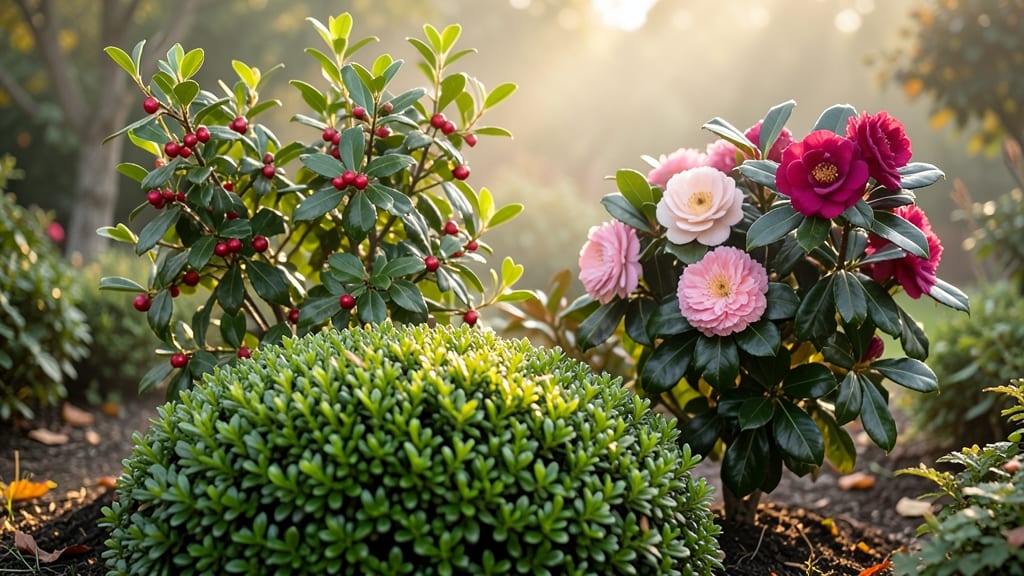
Year-round bushes and shrubs deliver lasting beauty in cold climates through evergreen leaves, colorful blooms, or vibrant berries, ensuring your landscape stays vibrant even when other plants fade. Standout cold-resistant options like boxwood, holly, and inkberry keep their color and structure through winter.
These hardy plants use clever survival tricks like thick, waxy coatings on leaves to prevent frost damage and deep root systems to access moisture even in frozen ground. 🌿 For example, boxwood's dense foliage acts as natural insulation, while holly's glossy leaves reflect sunlight to stay warmer.
The best part? Many of these shrubs also attract birds and pollinators year-round, adding extra life to your winter garden.
The real magic happens when you match the right shrub to your specific climate zone. Winterberry holly thrives in zones 3-9 and puts on a stunning red berry show in winter, while dwarf ninebark (zones 3-8) offers peeling bark that reveals vibrant new growth each spring.
These plants aren't just pretty—they're tough survivors that keep your landscape looking intentional through every season.
💡 In This Article
- How Cold-Hardy Shrubs Survive Winter’s Harsh Conditions
- Best Year-Round Shrubs for Different Garden Zones
How cold-hardy shrubs survive winter’s harsh conditions
Cold-hardy shrubs have evolved sophisticated survival strategies that allow them to maintain their structure and color even when temperatures drop below freezing. At the cellular level, these plants produce special proteins called antifreeze proteins that prevent ice crystals from forming within their cells.
For example, boxwood (Buxus spp.) contains these proteins along with a thick, waxy cuticle on its leaves that acts like a microscopic raincoat, reducing water loss and protecting against desiccation from winter winds.
This waxy coating can be up to 0.001 inches thick, making the leaves appear slightly glossy even in winter.
The root systems of these shrubs play an equally critical role. Many develop deep, extensive root networks that can reach 3-5 feet underground, allowing them to access moisture stored in deeper soil layers that remain unfrozen.
Inkberry (Ilex glabra) is particularly adept at this, with roots that spread horizontally while growing downward, creating a stable anchor that resists winter heaving caused by freeze-thaw cycles.
Additionally, some shrubs like dwarf lilac (Syringa meyeri) enter a state of partial dormancy where their metabolic processes slow dramatically, conserving energy while maintaining just enough activity to keep essential tissues alive.
Color retention in winter is often tied to specific pigment adaptations. Holly varieties like winterberry (Ilex verticillata) produce bright red berries that remain vibrant through the season due to high levels of anthocyanins—antioxidant pigments that actually become more concentrated in cold temperatures.
These pigments not only provide striking color but also protect the berries from oxidative damage. Meanwhile, evergreen shrubs like boxwood maintain their green hue through winter thanks to chlorophyll that remains stable at low temperatures, unlike deciduous plants that shed their leaves to conserve energy.
Light plays a surprising role in winter survival too. Many cold-hardy shrubs have leaves that are angled slightly upward, allowing them to capture more sunlight during the shorter winter days. This extra light energy helps maintain photosynthesis at reduced levels, providing the energy needed to keep tissues alive.
For instance, dwarf ninebark (Physocarpus opulifolius 'Little Devil') has leaves that angle at about 45 degrees, maximizing sunlight exposure even when snow covers the ground. This adaptation helps the plant continue producing energy at temperatures as low as -30°F.
One often-overlooked factor is how these shrubs handle snow accumulation. Their compact, dense growth habits prevent heavy snow from breaking branches, while their flexible stems can bend under 10-15 pounds of snow per square foot without permanent damage.
The combination of these structural adaptations—thick leaves, deep roots, efficient energy conservation, and snow-resistant forms—explains why these plants can maintain their beauty through winter when so many others fail. 🌟
What's particularly fascinating is how these adaptations work together in harmony. For example, the waxy leaf coating not only protects against cold but also reduces the plant's need for water during winter months. Meanwhile, the deep root system ensures the plant can still access moisture when surface soil freezes.
This dual protection system means cold-hardy shrubs can maintain their appearance without the energy expenditure required by less adapted plants. It's nature's perfect winter survival kit!