
Shrubs
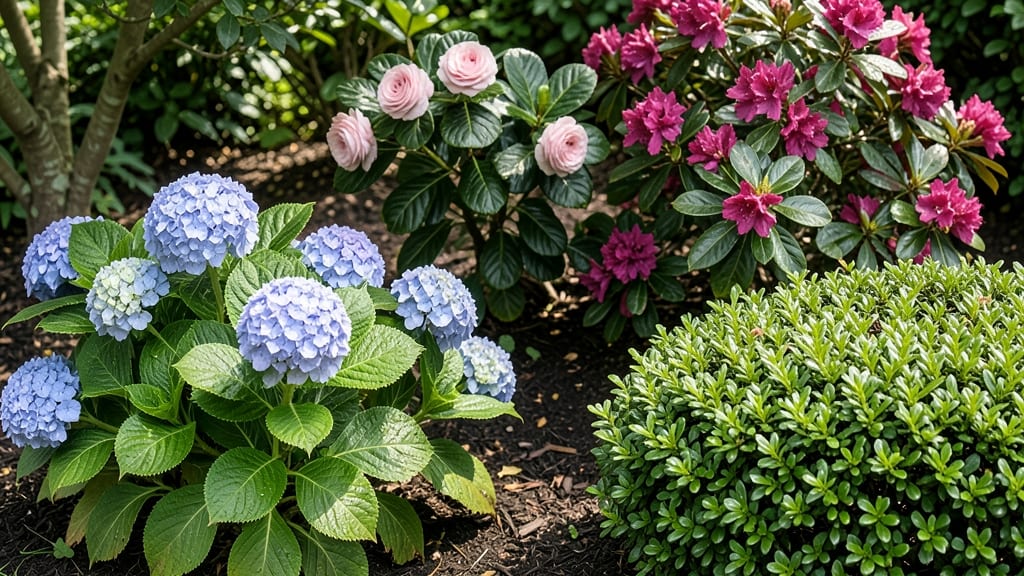
Shrubs look like compact, multi-stemmed plants with dense foliage that typically grow between 3 to 10 feet tall, featuring layered canopies and leaves that are either evergreen or deciduous.
Shrubs stand out from trees and herbs because their woody stems grow close to the ground in clusters rather than forming a single trunk. 🌿 This bushy structure creates a rounded or layered appearance, perfect for hedges or privacy screens.
Unlike trees, shrubs rarely exceed 10 feet in height, and their leaves can vary widely—from glossy evergreens like boxwood to vibrant seasonal blooms like azaleas. The bark texture also differs, often smoother or more textured than tree bark, adding to their distinct visual appeal.
Identifying shrubs becomes easier when you notice these key traits: their horizontal branching near the base, compact growth habit, and the way they fill space without vertical dominance. For example, a hydrangea spreads outward with lush clusters, while a juniper stays upright with needle-like foliage.
These visual cues help gardeners choose the right shrubs for their landscape needs.
💡 In This Article
- Distinguishing Shrub Structures from Trees and Herbs
- Identifying Common Shrub Types by Visual Traits
Distinguishing shrub structures from trees and herbs
Shrubs set themselves apart from trees and herbs through their unique multi-stemmed growth pattern. While trees develop a single, dominant trunk that grows vertically, shrubs produce multiple woody stems emerging from the base, creating a dense, bushy appearance.
This branching occurs because shrubs lack the apical dominance found in trees—a hormonal process where the top bud suppresses side growth. Without this suppression, shrubs grow outward in all directions, forming their signature layered canopies.
The height difference is another key identifier: shrubs typically stay between 3 to 10 feet tall, while trees can reach hundreds of feet.
Their compact stature makes them ideal for gardens, hedges, or borders. 🌿 The leaf arrangement also varies—shrubs often have opposite or alternate leaf patterns, unlike herbs which usually have simple, non-woody stems.
For example, a boxwood shrub has small, glossy leaves arranged in opposite pairs along its stems, while a tree like an oak has larger, alternate leaves with a single trunk.
Bark texture provides another clue: shrub bark tends to be smoother or more finely textured, often peeling or exfoliating in thin layers. Trees, especially mature ones, develop thicker, rougher bark with deeper grooves.
Seasonal changes also reveal differences—evergreen shrubs like holly retain their leaves year-round, while deciduous shrubs like lilacs shed leaves in autumn but regrow them in spring. This contrast helps distinguish them from herbaceous plants, which rarely develop woody stems and die back to the ground annually.
Consider the growth habit as another distinguishing factor. Shrubs like hydrangeas spread horizontally, creating a rounded shape perfect for mass plantings, while others like juniper grow upright with needle-like foliage. Trees, conversely, grow vertically with a clear central leader.
Even their root systems differ—shrubs develop shallow, fibrous roots that spread outward, whereas trees have deep taproots. These structural differences explain why shrubs thrive in smaller spaces while trees dominate larger landscapes.
When comparing shrubs to herbs, the woody stems become the defining feature. Herbs like basil or mint have soft, green stems that don't harden over time, while shrubs develop persistent woody tissue.
This woodiness allows shrubs to survive harsh winters and regrow each season, a trait absent in most annual herbs. 🌱 The combination of these visual and structural traits—multi-stemmed growth, compact height, and woody texture—makes shrubs instantly recognizable in any landscape.
For gardeners, understanding these differences is practical. Shrubs provide year-round structure, privacy, and seasonal interest, while trees offer shade and height. Herbs, though useful in cooking, lack the permanence and visual impact of shrubs.
By recognizing these key traits—multiple stems, dense foliage, and woody texture—you can confidently identify and select shrubs that fit your garden's design and maintenance needs.